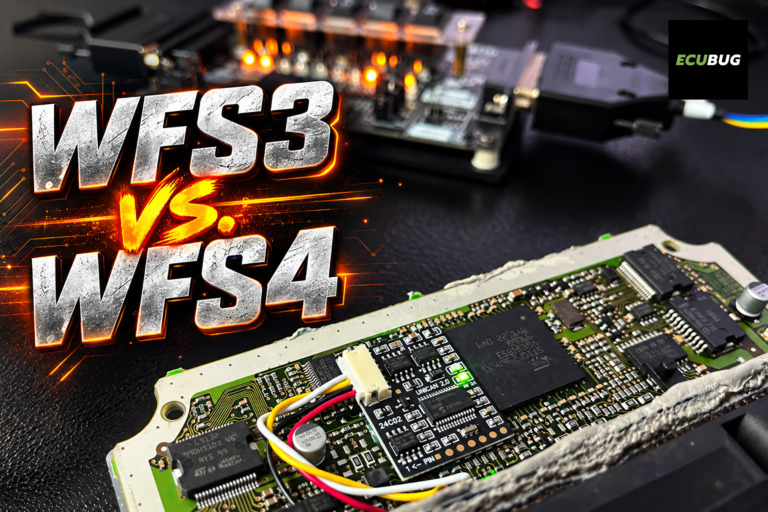
Electronic control units (ECUs) are complex systems governed by strict architectural and security constraints.
ECUBUG tools are designed to operate within these constraints, allowing for controlled technical flexibility where the ECU architecture permits. This article clarifies the intended purpose of our tools, our development methodology, and—equally important—their practical boundaries.
Defining ECUBUG Tools
ECUBUG tools are professional technical instruments engineered for specialists working directly with automotive electronic control units.
They are built to:
- Interface with specific ECU families and architectures.
- Support bench-level analysis, raw data access, and controlled system interaction.
- Assist in repair, recovery, migration, and validation scenarios.
- Reflect real-world ECU behavior, including edge cases and non-standard conditions.
Our tools are built on the premise that not all ECU problems have a single, binary solution.

Developed and Validated in a Real Repair Environment
ECUBUG tools and methodologies are not theoretical; they are developed and validated using real-world ECU repair cases.
Our validation process involves control units affected by:
- Physical hardware failures.
- Corrupted, incomplete, or missing data structures.
- Failed programming sequences or interrupted updates.
- Immobilizer-related system lockouts.
In specific scenarios, validation involves reconstructing required ECU data using information derived from other vehicle modules (where the architecture allows such correlation). This development model ensures that ECUBUG solutions are based on observed system behavior, not assumptions.
The “Hardware-First” Philosophy
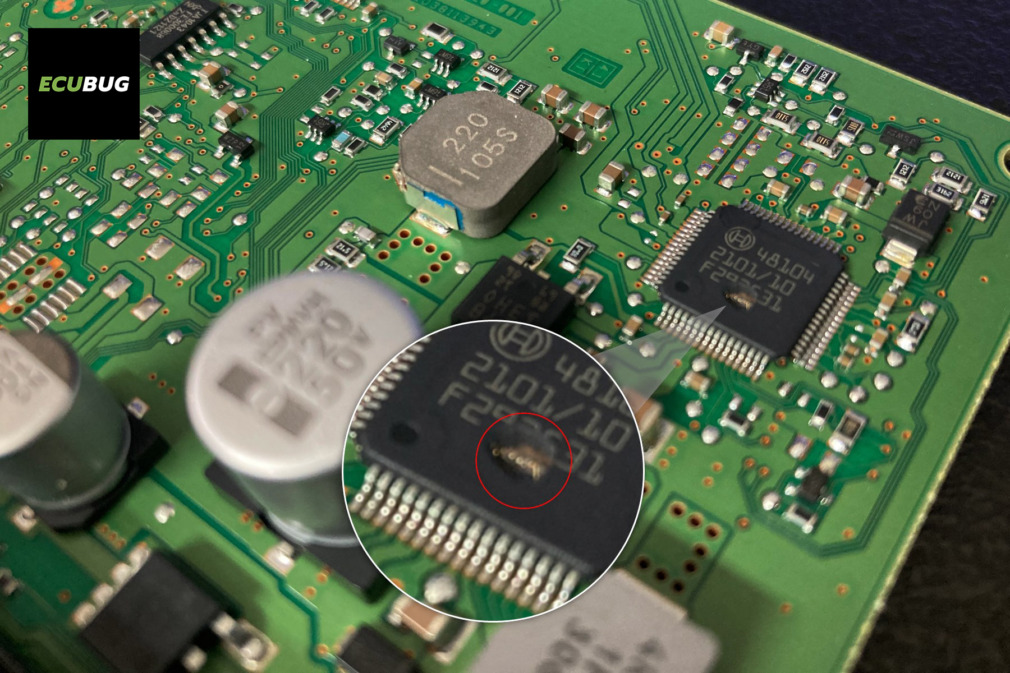
Whenever possible, ECUBUG solutions rely on hardware-based interaction or controlled emulation. This approach prioritizes preserving the original ECU logic and system behavior.
However, software-based approaches are not ignored. They are considered strictly when:
- No viable hardware solution exists.
- The ECU architecture explicitly permits such modification.
- The resulting behavior remains technically stable and predictable.
Software solutions are therefore treated as architecture-dependent fallback options, not universal methods.

Data Recovery is Not Always Binary
We recognize that ECU data states are not limited to simply being “present” or “lost.”
In practice:
- Some data may be partially corrupted.
- Some data can be mathematically reconstructed.
- Some data must be derived from the system context (other modules).
- Some data is unrecoverable by definition.
ECUBUG tools support analysis and reconstruction workflows where technically justified, while clearly distinguishing between recoverable and non-recoverable cases.
Experimental and Validation Use Cases
Beyond repair, ECUBUG tools are valuable in experimental, research, and validation contexts, such as:
- Controlled testing of ECU responses.
- Validation of repair hypotheses.
- Analysis of undocumented system behaviors.
- Development of ECU-specific technical approaches.
Note: These use cases require advanced technical knowledge and are not intended for casual experimentation.
What ECUBUG tools are NOT
To ensure the right fit for your needs, it is crucial to understand what these tools are not:
- ❌ Universal ECU solutions: They are specialized instruments.
- ❌ Plug-and-play devices for non-professionals: They require expertise.
- ❌ Standard vehicle diagnostic tools: They operate at the ECU level, not the OBD level.
- ❌ Guaranteed repair outcomes: Tools enable the repair; they do not guarantee it.
They do not override ECU architecture, security models, or physical hardware limitations.
Why Universal Solutions Do Not Exist
Two ECUs with identical part numbers may:
- Differ in internal memory layout.
- Utilize different security implementations.
- Behave differently after firmware updates.
- Respond differently to identical datasets.
For this reason, a “universal” one-click solution is a technical impossibility, even if tools and data appear similar on the surface.
Known Limitations
We believe in transparency. ECUBUG tools:
- Cannot guarantee data reconstruction in every unique case.
- Cannot bypass fundamental architectural security models designed into the silicon.
- Cannot restore logic that has been physically destroyed.
- Cannot ensure identical behavior across all firmware variants.
These are not product constraints; they are technical realities of modern automotive electronics.
Who is this for?
ECUBUG tools are intended for:
- Professional ECU repair specialists.
- Advanced automotive electronics workshops.
- Engineers working with ECU-level systems.
- Controlled research and validation environments.
Conclusion
ECUBUG tools exist to enable informed technical decisions, not to promise magic outcomes. They support multiple technical paths—hardware-based, software-based, and experimental—provided those paths respect the ECU’s architecture.
Understanding these limitations is not a restriction. It is the foundation of reliable ECU work.