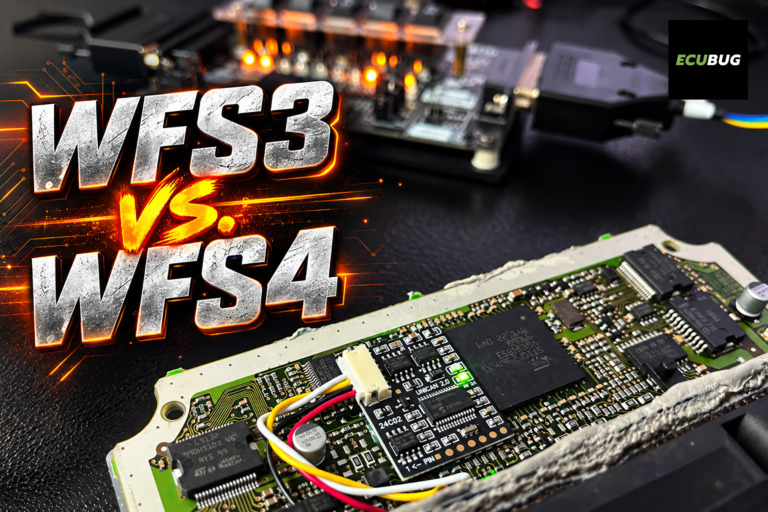
Whether you are performing an engine swap into a track car, dealing with a corrupted instrument cluster, or facing a lost-key situation where the dealer quote is higher than the car’s value, you will eventually hit a wall: The Immobilizer (IMMO).
When the ECU does not receive the correct authorization signal from the key/dashboard, it shuts down the engine after 1 or 2 seconds.
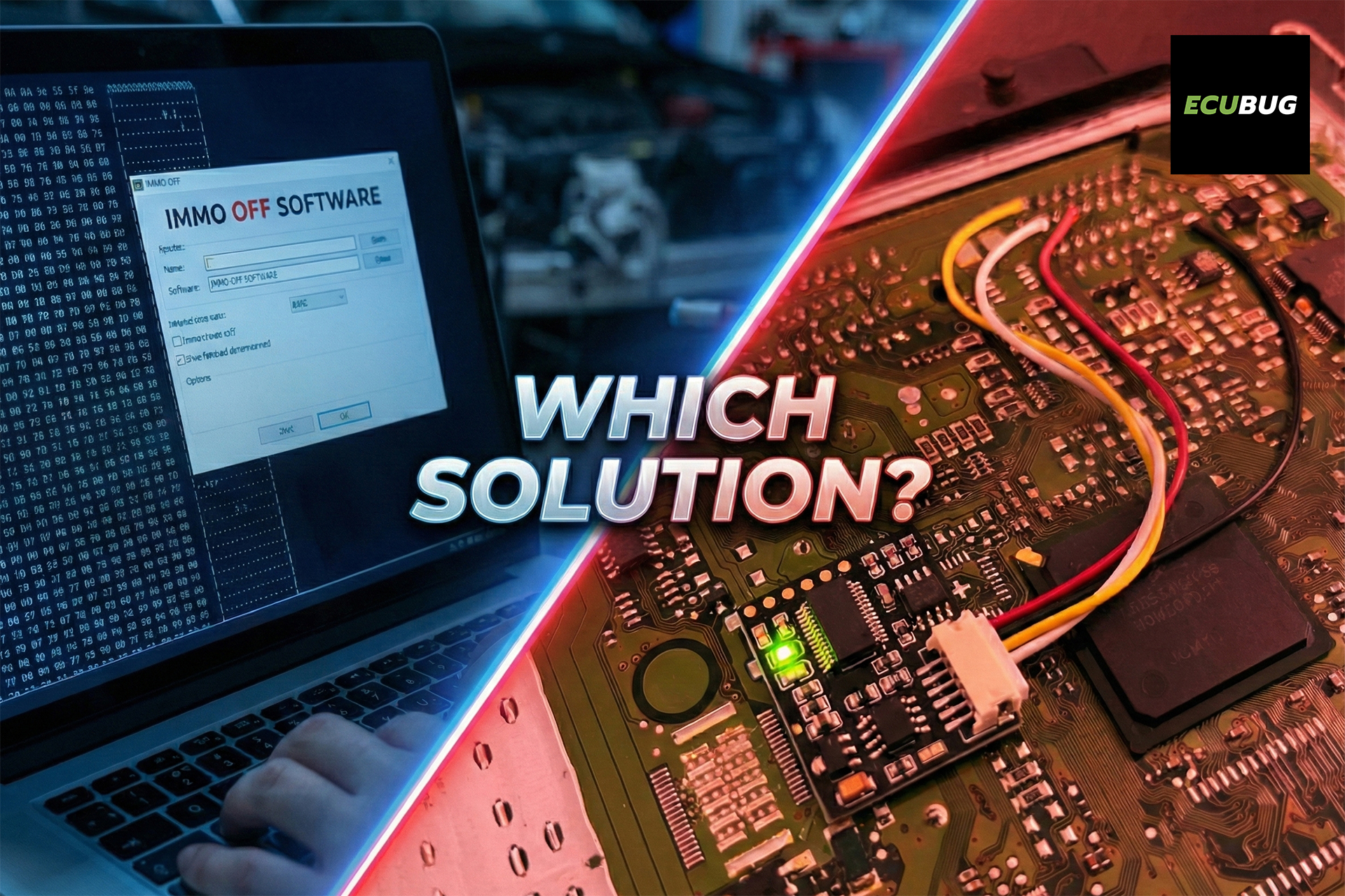
To bypass this, mechanics and tuners generally use one of two methods: a Software IMMO OFF (permanent delete) or a Hardware IMMO Emulator. But which one is the right choice for your specific project? Let’s break down the pros, cons, and best use cases—especially for the legendary Bosch EDC15 and EDC16 ECUs.
Important Note regarding ECUBUG:
We are a specialized provider of electronic diagnostic tools, software, and hardware emulators. > Please note that we are NOT a repair garage and we do not accept vehicles for service. We supply the components for qualified professionals and motorsport engineers.
Disclaimer: Immobilizer bypass solutions are strictly intended for diagnostic testing, motorsport, or off-road engine swap applications. Always adhere to local laws.
Option 1: Software “IMMO OFF” (Permanent Delete)
What is it?
IMMO OFF involves reading the memory of the ECU (usually the EEPROM, and sometimes the Flash memory), modifying the specific hex values that control the immobilizer routine, and writing the modified file back to the ECU.
The Pros:
- No Extra Hardware: You don’t need to buy or solder any physical devices inside the ECU or on the wiring harness.
- Clean Look: Since everything is done via software, the wiring remains 100% factory.
- Cost-Effective (if you have the tools): If you already own an ECU programmer (like KESS, KTAG, MPPS, or an EEPROM reader), the only cost is the software calculation.
The Cons:
- Risk of Corruption: Editing EEPROM data incorrectly can brick the ECU or cause other dashboard errors (e.g., flashing glow plug lights or “DEF” on the cluster).
- Dealer Overwrites: If the car goes to a dealership for a software update, the IMMO OFF patch will be overwritten, and the car will fail to start again.
- Tool Dependency: You need specific, sometimes expensive tools to read the ECU on the bench or via OBD.
Option 2: IMMO Emulator (Hardware Bypass)
What is it? An IMMO Emulator is a small microchip board that you wire into the car’s communication network (K-Line or CAN-BUS). Instead of deleting the immobilizer from the ECU’s brain, the emulator actively sends a continuous “Key Accepted / Authorized” digital signal to the ECU.
The Pros:
- Original Software Intact: You do not touch the original ECU flash or EEPROM data. There is zero risk of bad checksums or software corruption.
- Perfect for Engine Swaps: If you are putting an engine into a boat, a buggy, or an older chassis without the original dashboard and key reader, an emulator simulates the missing car network perfectly.
- Easy Diagnostics: An emulator usually features a status LED (e.g., blinking = searching, solid = authorized), making it very easy to diagnose communication faults.
The Cons:
- Requires Soldering: You need basic soldering skills to connect 3 or 4 wires (Power, Ground, CAN High/K-Line, CAN Low) to the ECU wiring or inside the unit.
- Hardware Cost: You have to purchase the physical emulator board for the job.
The Classic Battleground: Bosch EDC15 vs. EDC16
Let’s look at how this applies to the two most common engine control units in the tuning and swap world: the Bosch EDC15 and EDC16 platforms.
Bosch EDC15 (Common in VAG 1.9 TDI)
The EDC15 is famous for its simplicity.
- The Verdict for EDC15: Software IMMO OFF wins. * Why? The IMMO data in the EDC15 is stored in a simple 24C04 EEPROM. It is incredibly easy to read and modify using basic tools or software. Because it is so simple to turn off in the software, installing a physical emulator is usually unnecessary extra work, unless the EEPROM chip itself is physically burned out.
Bosch EDC16 (VAG, PSA, FIAT, etc.)
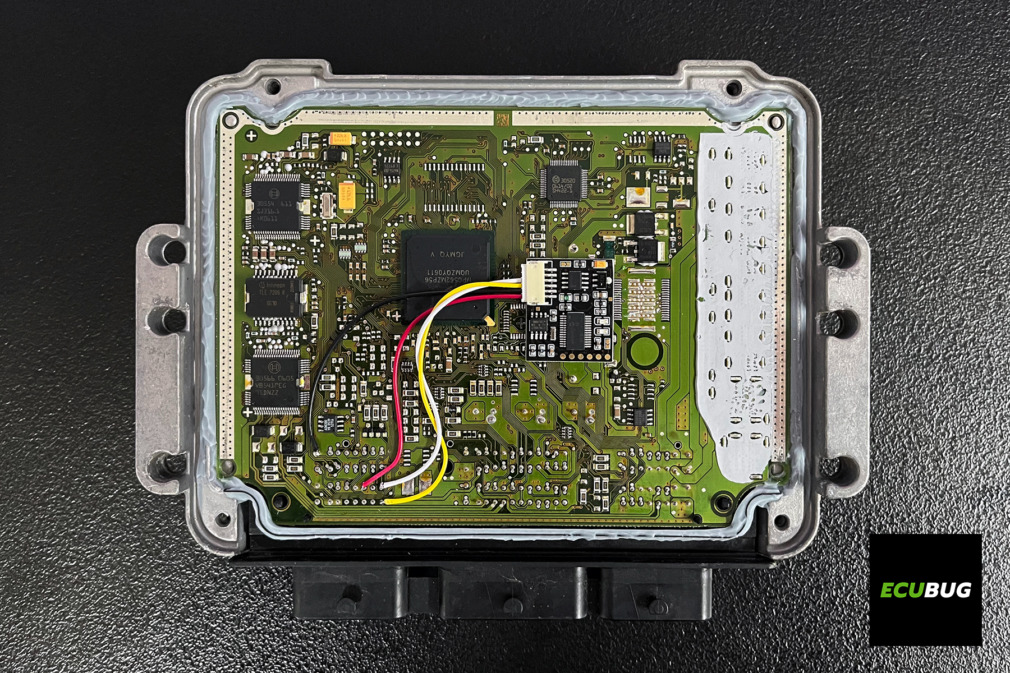
The EDC16 generation introduced much more complex security, strict checksums, and CAN-BUS communication across all car manufacturers (including the PSA EDC16C34 shown in the photo below).
- The Verdict for EDC16: Emulator is highly recommended.
- Why? While modern tuning tools allow you to easily read the EDC16 on the Bench without opening it (or via traditional BDM), the real problem lies in the modified software itself. Bad software IMMO deletes on EDC16 frequently leave the dashboard immobilizer light flashing permanently, log constant fault codes, or even disable the cruise control. Installing a universal IMMO Emulator (whether wired to the harness or soldered inside the ECU, as seen below) is a cleaner solution. It actively mimics the original CAN-BUS signals, keeping the car’s network and diagnostics 100% happy.
Summary: Which should you choose?
| Feature | Software IMMO OFF | IMMO Emulator |
| Best For: | Older ECUs (EDC15), stock cars with lost keys | Complex ECUs (EDC16+), Engine Swaps, Buggies |
| Risk of Bricking ECU: | Higher (Requires data modification) | Very Low (Leaves software original) |
| Dealership Updates: | Can erase the IMMO OFF | Does not affect the emulator |
| Installation: | Reading/Writing with a programmer | Soldering 3-4 wires |
The Bottom Line:
If you are dealing with early 2000s K-Line ECUs, software is usually the fastest route. But as soon as you step into CAN-BUS territory (EDC16, EDC17, PCR2.1) or you are building a custom project vehicle, a Hardware Emulator is the safest, most reliable way to bypass security without fighting software glitches.
Need a reliable bypass solution for your project?
Whether you need high-quality emulators that work the first time or the database solutions to calculate your EEPROM files, we have the tools you need.